Work Requests
How you order localized versions of an asset — what a work request contains, the stages it moves through, and who acts at each step.
How you order localized versions of an asset — what a work request contains, the stages it moves through, and who acts at each step.
A work request is an order to produce localized versions of an asset. When a territory needs a trailer subtitled in French, the key art adapted for Japan, or audio dubbed for Germany, that work is captured as a work request and tracked from order to delivery.
You build an order on the Place Order page. The assets you’re ordering for sit in the Assets List on the left, the order details fill the center, and a running Your Order summary with a live Cost Estimate stays on the right.
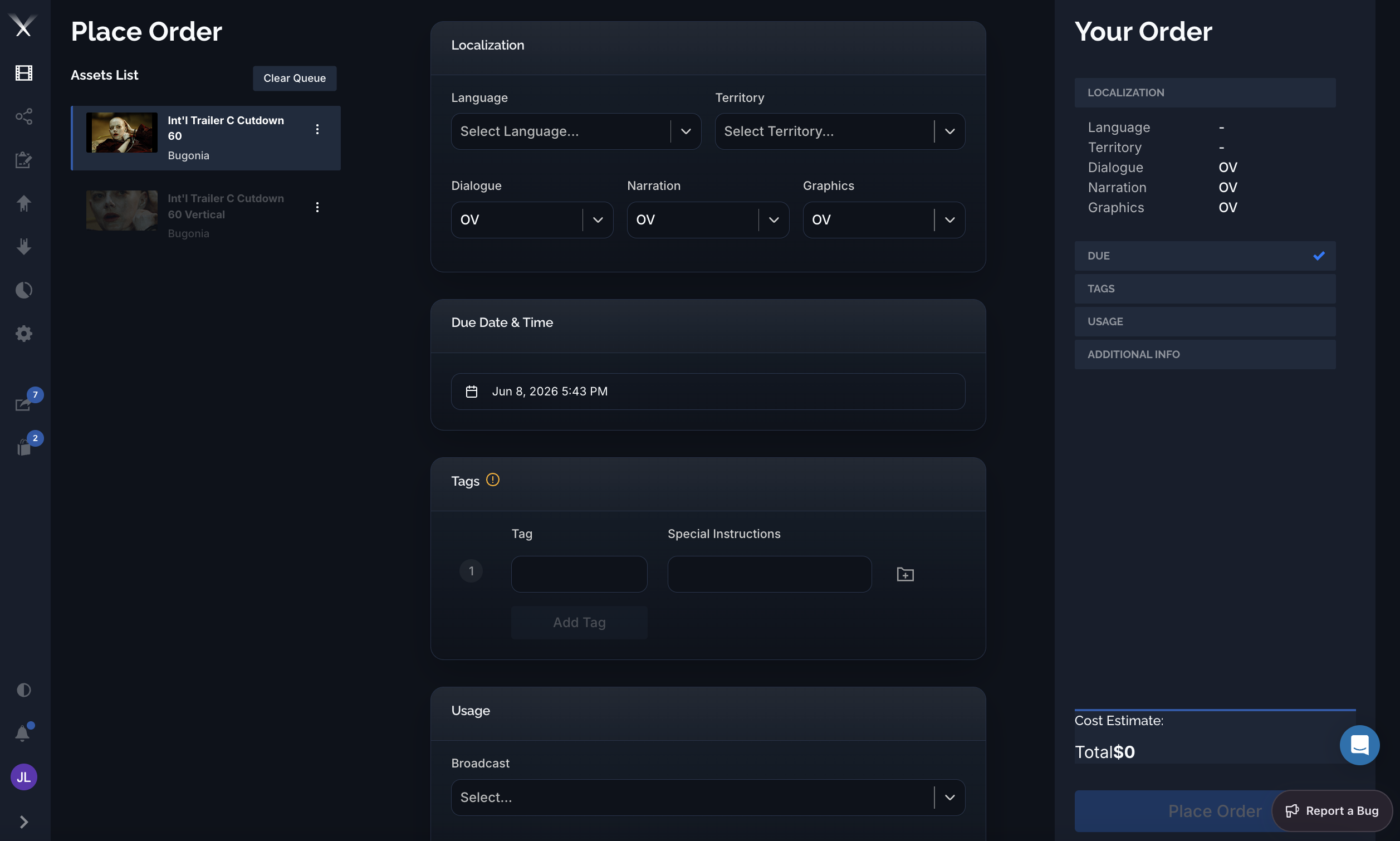
Each work request describes the localization you need:
A work request moves through a defined set of stages. You always know where an order stands by its status.
The order is being drafted. All fields can still be edited; it hasn’t been submitted yet.
The order has been sent to Pixwel for processing.
The order is waiting on required source material (for example dubbed audio or graphics) before work can begin.
The team is actively producing the localized assets.
A preview (an offline) is ready for the client to review and either approve or send back.
Once approved, the final files are prepared and delivered, and the order is marked complete.
An order can also be Rejected (sent back for changes, returning to an earlier stage) or Cancelled at most points. The full set of statuses you’ll see is: Incomplete, Submitted, Awaiting Materials, In Progress, For Review, Approved, Rejected, Complete, Cancelled.
An offline is a workprint or preview version sent for approval — not the final deliverable. The final, delivered files arrive when the order reaches Complete.
Open a work request and you get the order’s whole life in one view. The left panel holds the order’s details — language, territory, the DNG choices (here dialogue Subtitled, narration OV, graphics Dedicated / Localized), who requested it, dates, translator, and deliverables — under Overview, Discussion, Tags, and Files tabs.
The right side is the timeline: every stage the order has passed through, newest at top, each entry stamped with who acted and when. As work progresses you see the delivered files at Complete, the approved tags and deliverables at Approved, and the reviewable offline — with a version selector (v1, v2, …) and an inline player — at Awaiting Approval. Watermarked previews carry the viewer’s email.
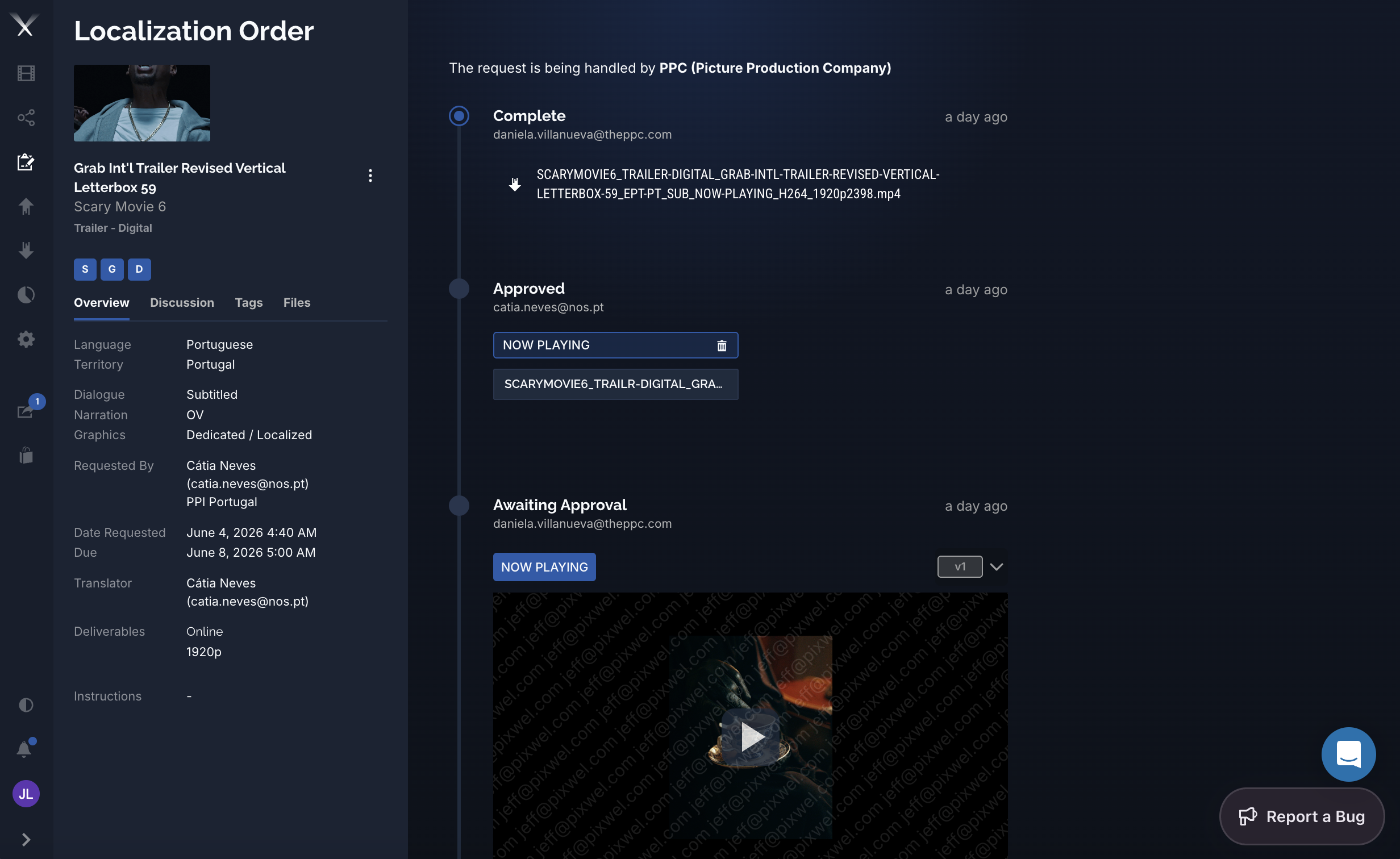
The banner up top shows who’s handling the request — the assigned localization vendor (for example PPC — Picture Production Company).
Within a work request, people act in different roles:
| Role | Does |
|---|---|
| Owner | The person (studio or territory user) who created the order. Edits it while incomplete, approves or rejects the preview, and can cancel. |
| Manager | Moves the order through its stages — starts work, submits for review. |
| Vendor | The localization partner who produces the work and uploads previews and final files. |
| Translator | Produces the subtitle or graphics translation for the order. |
| Admin | Can perform any action and override transitions. |
As an order progresses it generates translations (the localized subtitles or graphics), then offlines for review, and finally the delivered files — all attached back to the original asset. The result is a new set of localized versions sitting alongside the source, ready to share and download.